

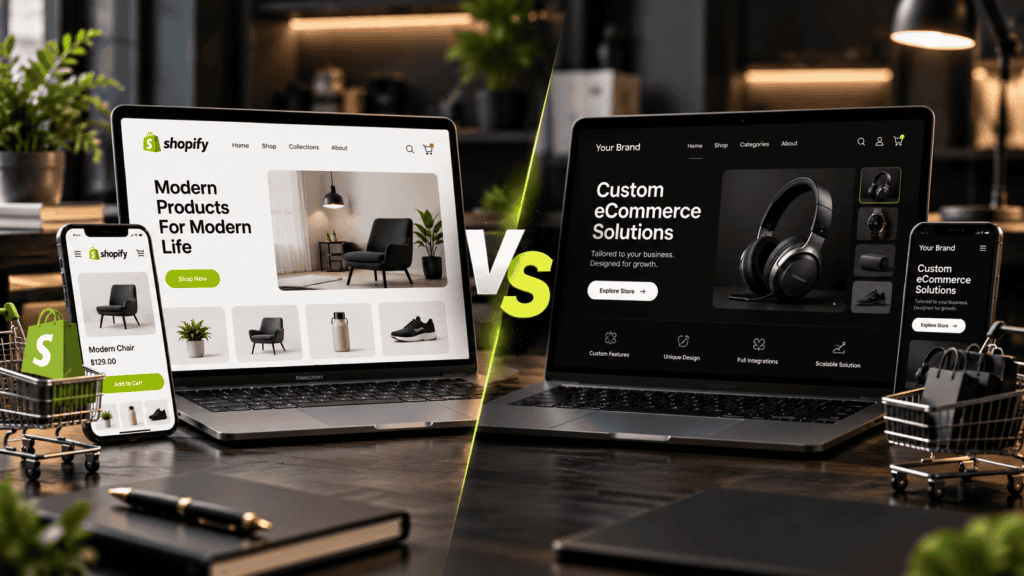
Shopify vs Custom eCommerce Website: Which Is Better for Your Business in 2026?
Choosing the right eCommerce platform is an important decision for any business planning to sell products online. Your website affects how customers shop, how you manage orders, and how easily your business can grow.
Two popular options are Shopify and a custom-built eCommerce website. Both can help you build an online store, but they offer different levels of flexibility, control, maintenance, and cost.
At EpicSoft Studio, we help businesses explore digital solutions that match their goals, workflows, and long-term plans. In this guide, we compare Shopify and custom eCommerce development to help you make a more informed decision.
What Is Shopify?
Shopify is a hosted eCommerce platform that allows businesses to create and manage online stores without building the entire system from scratch.
It provides store management tools, product catalogues, order processing, themes, payment integrations, and an app ecosystem. Its hosted structure also means Shopify manages much of the underlying platform infrastructure.
Advantages of Shopify
- Faster launch: Start with an existing theme and customise it to suit your brand.
- Simplified store management: Manage products, inventory, orders, and customers through a central dashboard.
- App integrations: Add functionality through compatible apps and integrations.
- Hosted infrastructure: Shopify manages much of the platform’s technical infrastructure.
- Room to grow: Add products, sales channels, and supported features as your business develops.
What to consider
Shopify has subscription fees, and some themes, apps, or third-party services may involve additional costs. Highly specialised functionality may require custom development, and the platform has limits on how deeply certain parts of the system can be modified.
Shopify is often a strong option for businesses that want a practical, manageable route to online selling.
What Is a Custom eCommerce Website?
A custom eCommerce website is developed around a business’s specific requirements. It may use a framework, content management system, or custom backend selected according to the project’s needs.
Rather than adapting every business process to a predefined platform, the development team can design workflows and features around the business.
Advantages of Custom eCommerce Development
- Greater flexibility: Build specific features and workflows around your business requirements.
- Tailored customer experience: Design the shopping journey to match your products, audience, and brand.
- Integration options: Connect business systems, APIs, and third-party services where technically supported.
- Control over architecture: Select the technology stack and system structure according to your needs.
- Specialised functionality: Build advanced pricing rules, custom dashboards, or complex business processes when required.
What to consider
Custom development usually requires more planning, design, development, testing, and ongoing maintenance. Costs depend on the project’s complexity and scope. You may also need to arrange hosting, security updates, backups, performance monitoring, and technical support.
A custom website is most valuable when your requirements justify that additional investment and responsibility.
Shopify vs Custom eCommerce: Key Differences
1. Development Time
Shopify can often be launched faster because the core commerce features already exist. The timeline depends on your catalogue, design requirements, integrations, and customisations.
A custom eCommerce website requires more decisions and development work. Complex features and integrations can extend the delivery timeline.
Best fit: Shopify for a quicker launch; custom development when the business needs a more specialised solution.
2. Initial and Ongoing Costs
Shopify typically involves a subscription, theme or app expenses where applicable, and development or maintenance costs for additional work.
Custom eCommerce costs depend on design, features, technology, integrations, hosting, and ongoing support. A simple custom store and a complex marketplace can have very different budgets.
Do not compare platforms on initial development price alone. Consider the total cost of ownership, including subscriptions, transaction-related fees where applicable, maintenance, and future changes.
Best fit: Compare actual project quotes and ongoing costs against your requirements rather than assuming one option is always cheaper.
3. Design and Customisation
Shopify offers themes and customisation tools that can create a professional branded storefront. More advanced changes may require development and must work within Shopify’s platform structure.
Custom eCommerce offers more freedom over the interface and underlying workflows, provided the budget, technology, and development team support those requirements.
Best fit: Shopify for theme-based or moderately customised stores; custom development for experiences that require deeper control.
4. Integrations and Business Workflows
Shopify supports many integrations through its app ecosystem and APIs. This can cover common requirements such as marketing, fulfilment, analytics, and inventory tools.
Custom websites can be built around specialised integrations or workflows, although each integration requires technical planning, implementation, and maintenance.
Best fit: Shopify for commonly supported integrations; custom development for unusual or highly specialised workflows.
5. Scalability and Maintenance
Both approaches can support business growth when designed and managed properly.
Shopify reduces the amount of platform infrastructure your team needs to manage directly. However, app dependencies, subscription costs, and platform constraints still need consideration.
A custom website can be architected for specific growth requirements, but its performance, security, and reliability depend on the quality of the implementation and ongoing maintenance.
Best fit: The option that matches your expected growth, technical resources, and operational needs.
Which Option Is Right for Your Business?
There is no single platform that works best for every business. Start by identifying what you need to sell, how you will manage orders, and which features are essential from day one.
Choose Shopify if:
- You want to launch an online store without building the entire commerce system from scratch.
- Your requirements fit Shopify’s available features and integrations.
- You prefer a managed platform with a straightforward administration experience.
- You want to focus more on products, marketing, and sales than on maintaining the underlying infrastructure.
Choose Custom eCommerce if:
- Your business depends on specialised features or complex workflows.
- You need greater control over the technology and system architecture.
- Your requirements cannot be met effectively through Shopify’s standard features and available extensions.
- You have the budget and resources for custom development and ongoing technical support.
What if you need both?
Some businesses benefit from a hybrid approach. For example, Shopify may handle the online store while custom integrations support specific business processes. In other cases, a separate custom application may be appropriate alongside the commerce platform.
The right architecture depends on how your systems need to work together.
Questions to Ask Before Making a Decision
Before choosing your platform, answer these questions:
- What products will you sell, and how large is your catalogue?
- Do you need subscriptions, wholesale pricing, multiple vendors, or complex product options?
- Which payment, shipping, inventory, and accounting systems must connect to your store?
- What is your initial budget, and what ongoing costs can you support?
- Who will manage updates, security, performance, and technical support?
- What features will you need as your business grows over the next few years?
Clear answers to these questions can help prevent unnecessary development costs and platform changes later.
Build the Right eCommerce Solution with EpicSoft Studio
Your eCommerce website should support the way your business operates, not make everyday tasks more complicated.
At EpicSoft Studio, we work on web development, Shopify and eCommerce solutions, mobile applications, UI/UX design, and custom software. We focus on understanding your business requirements before recommending an appropriate development approach.
Whether you need a Shopify store, a tailored online shopping experience, or custom integrations, the first step is to define your goals and priorities.
Ready to plan your eCommerce project?
Contact EpicSoft Studio to discuss your requirements and explore the right solution for your business.